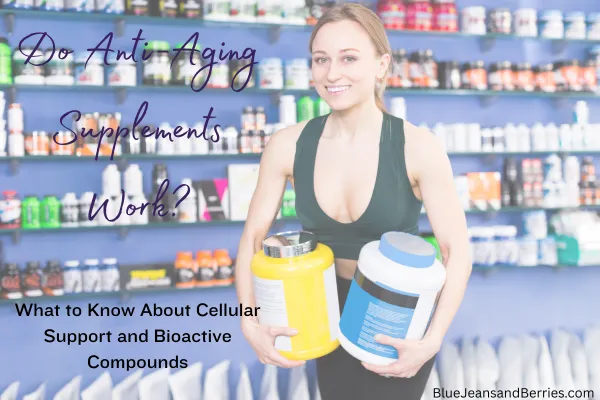
Do Anti-Aging Supplements Work? What to Know About Cellular Support and Bioactive Compounds
Walk into any health store or scroll online for five minutes, and you’ll see it:
“Anti-aging supplements that turn back the clock.”
“Longevity pills.”
“Cellular repair in a capsule.”
It’s tempting to believe there’s a shortcut.
But let’s take a breath and look at what the science actually says.
Do supplements play a role in healthy aging?
Yes.
Are they the magic solution?
Not even close.
The truth sits somewhere in the middle—and that’s where we’re going to focus.
First Things First: You Can’t Supplement Your Way Out of Poor Habits
Before we talk about what can help, let’s be clear about what doesn’t.
No supplement can override:
a diet low in whole foods
chronic sleep deprivation
high stress levels
lack of movement
If the foundation isn’t there, supplements become expensive “hope in a bottle.”
Healthy aging starts with:
✔ Whole food nutrition
✔ Movement and muscle
✔ Quality sleep
✔ Stress management
Supplements are meant to support that foundation—not replace it.
Where Supplements Do Fit In
Now here’s the encouraging part.
When your foundation is in place, certain nutrients and compounds can help support:
cellular protection
inflammation balance
mitochondrial function
immune health
recovery and repair
Think of supplements like adding insulation to a well-built home.
They don’t build the structure, but they can make it more efficient.
Key Players in the Anti-Aging Conversation
Let’s break down a few of the most talked-about categories—without the hype.
1️⃣ Antioxidants & Polyphenols
These compounds help neutralize oxidative stress, one of the major drivers of cellular aging.
You’ll find them naturally in:
fruits
vegetables
berries
green tea
dark leafy greens
Whole-food-based sources are especially powerful because they contain synergistic compounds that work together.
This is one reason nutrition always comes first.
2️⃣ Omega-3 Fatty Acids
Omega-3s support:
heart health
brain function
inflammation balance
Many people don’t get enough through diet alone, especially if they don’t regularly eat fatty fish.
Supporting healthy fat intake can play a role in long-term cellular health.
3️⃣ Protein & Amino Acids
As we age, maintaining muscle becomes critical.
Protein provides the building blocks needed for:
muscle repair
immune function
metabolic health
This isn’t always thought of as “anti-aging,” but it absolutely should be.
Muscle is one of the strongest predictors of healthy aging.
4️⃣ Bioactive Compounds & Peptides
This is one of the newer and more exciting areas of research.
Bioactive compounds and peptides are being studied for their potential role in:
cellular signaling
recovery
tissue repair
metabolic support
While research is still evolving, this category is gaining attention for its potential to support how our bodies function as we age.
The key here is quality, education, and realistic expectations.
The Whole Food Advantage
Here’s something many people overlook:
Nutrients don’t work in isolation.
In whole foods, vitamins, minerals, fiber, and phytonutrients interact in complex ways that enhance absorption and effectiveness.
That’s why getting nutrients from real food is always the goal.
For busy families and professionals, consistently hitting their optimal intake of fruits and vegetables can be challenging.
This is where whole-food-based supplements can help fill in the gaps—providing concentrated plant nutrition in a convenient form.
Not as a replacement.
But as reinforcement.
A Smarter Approach to Supplementation
If your goal is to support healthy aging, here’s a simple framework:
1. Start with food
Build meals around whole, colorful, nutrient-dense foods.
2. Identify gaps
Where are you consistently falling short?
3. Choose quality over quantity
More supplements don’t mean better results.
4. Stay consistent
Small daily support matters more than occasional extremes.
5. Keep expectations realistic
Supplements support your body—they don’t override biology.
The Goal Isn’t More Supplements. It’s Better Function.
It’s easy to get caught up in the idea of “more.”
More products. More protocols. More promises.
But healthy aging isn’t about chasing the newest trend.
It’s about supporting how your body functions over time.
When you:
Reduce inflammation
Support nutrient intake
Protect your cells
Maintain muscle
Improve recovery
You’re creating an environment where your body can thrive.
So… Do Anti-Aging Supplements Work?
They can.
But only when used in the right context.
Supplements are tools—not solutions.
When combined with strong daily habits, they can help support:
✔ cellular health
✔ energy production
✔ recovery
✔ resilience
And that’s what aging well is really about.
Want to Build a Simple, Sustainable Longevity Plan?
If you’ve ever felt overwhelmed by all the supplement options out there, you’re not alone.
That’s exactly why I focus on helping people simplify their approach to health.
Inside my community, we focus on:
whole food nutrition first
realistic daily habits
strategic supplementation when needed
long-term consistency over quick fixes
If you’d like help building a plan that fits your life, I’d love to support you.
Continue the Series
This article is part of my Reverse Aging series, where we break down science-backed ways to support how we age—without overwhelm.
If you missed the first two articles:
👉 Can You Reverse Aging? (The Science Explained)
https://bluejeansandberries.com/post/can-you-reverse-aging-what-the-science-really-says-about-slowing-the-aging-process
👉 Eat to Age Backwards (Nutrition & Cellular Repair)
https://bluejeansandberries.com/post/eat-to-age-backwards
Next up:
Sleep and Cellular Repair — why rest might be your most underrated anti-aging tool.
With vitality & joy,
Terry
#BlueJeansandBerries